ISAMS 2026 강의 동영상
강의명 (Class)
강사명 | Yi-Hung Chen 강의시간 | 24분 강의개설일 | 2025-12-10
※동영상은 사단법인 약침학회 가입을 하셔야 시청 가능합니다.
강의소개
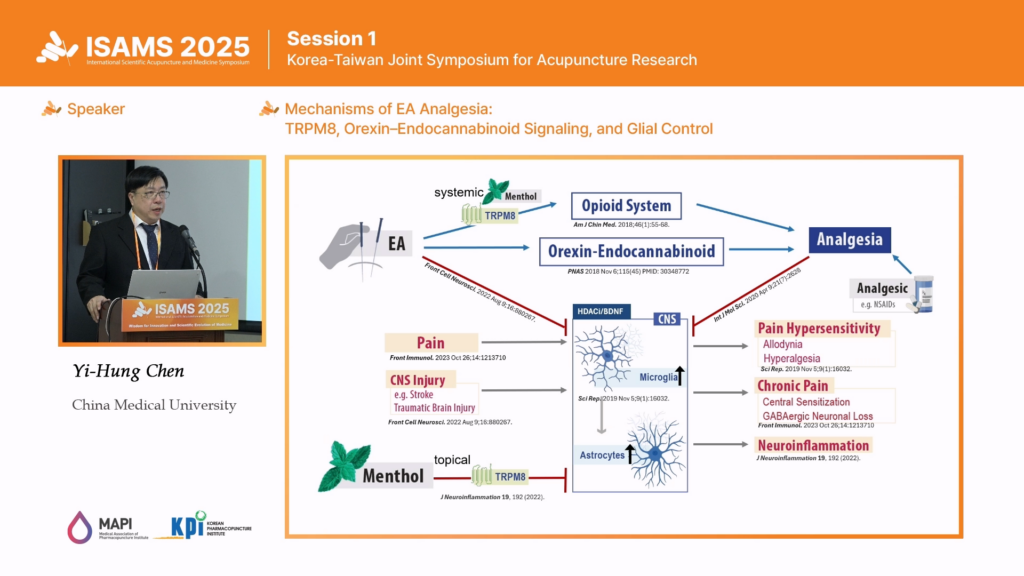
Acupuncture—the stimulation of defined body points with needles—has been practiced for ~2,500 years and is recognized by the WHO for multiple indications. Electroacupuncture (EA), developed in the 1950s for surgical anesthesia, applies controlled electrical currents through needles and produces reliable analgesia. This lecture interprets the accompanying figure to propose an integrated CNS framework: EA activates peripheral afferents, reshapes spinal and supraspinal circuits, and engages both opioid and non-opioid mechanisms. Early work established endogenous opioids; recent studies define a parallel orexin endocannabinoid pathway that operates independently of opioids. Our new research identifies TRPM8 (transient receptor potential melastatin 8)—the cold/menthol-gated ion channel—as a mechanistic gate for EA: intact TRPM8 permits recruitment of endogenous opioids, whereas its inhibition or deletion shifts analgesia toward cannabinoid signaling. Converging on neuroimmune targets, EA suppresses microglial and astrocytic activation, lowers pro-inflammatory mediators, and mitigates central sensitization and GABAergic dysfunction—the drivers of allodynia, hyperalgesia, and pain chronification. These glial centric effects also confer neuroprotection after CNS injury (e.g., stroke, traumatic brain injury). Translationally, we show that: (i) EA at clinically relevant acupoints (e.g., PC6) alleviates pain via the orexin–endocannabinoid axis and retains efficacy in opioid-tolerant states; (ii) EA reduces glial reactivity and neuroinflammation after experimental brain trauma; and (iii) EA relieves severe dental pain and may limit the transition to chronic pain (e.g., irreversible pulpitis). Together, these data position EA as a multimodal, non-pharmacologic strategy that coordinates opioid and non-opioid systems while reprogramming neuroimmune responses—supporting evidence-based use of EA for pain management and neuroprotection.
강사소개
Professor Yi-Hung Chen is Associate Dean of the College of Chinese Medicine at China Medical University and Director of the International Master’s Program in Integrative Health. He received his Ph.D. in Pharmacology from National Taiwan University and has worked at Temple University in the United States as a visiting scholar. Professor Chen’s work integrates basic and clinical research to investigate pain relief and neuroprotection mechanisms of acupuncture through modern biomedical approaches. His research has revealed non-opioid mechanisms of electroacupuncture analgesia, such as activating the orexin and endocannabinoid systems via median nerve stimulation to modulate pain in the midbrain, a study published in PNAS. He also explores neuroprotective strategies in animal models of Parkinson’s disease and dental injury, focusing on factors like BDNF, HDAC, and microglial activation. Recently, his team has studied the potential of topical menthol to activate TRPM8 channels through the skin, offering a possible neuroprotective approach for ischemic stroke. Professor Chen’s work advances innovative strategies for stroke rehabilitation, chronic pain, and neurodegenerative diseases, contributing to the modernization and global integration of traditional Chinese medicine.
강사명 | Doyoung Kwon 강의시간 | 18분 강의개설일 | 2025-12-09
※동영상은 사단법인 약침학회 가입을 하셔야 시청 가능합니다.
강의소개
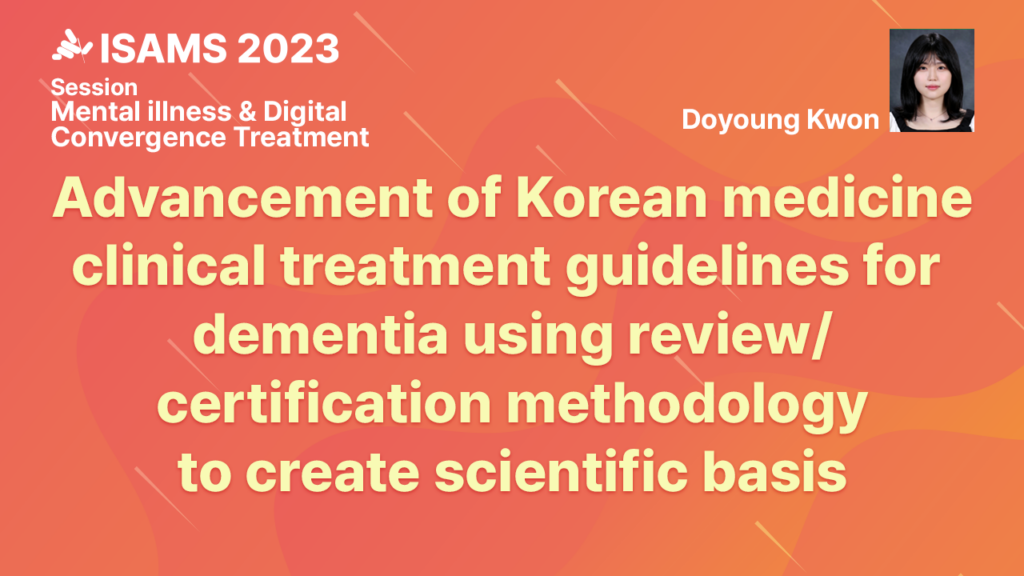
Objectives: The objectives of this study were to develop clinical practice guidelines (CPGs) for Korean medicine (KM) on Dementia using the adaptation methodology, and to evaluate the feasibility and efficiency of this approach. Methods: We followed the adaptation methodology published by NECA, which consists of three phases: planning, adaptation, and finalization. We selected Dementia as the topic of interest based on the priority criteria and searched for relevant studies from domestic and international sources. We assessed the quality, currency, content, applicability, and acceptability of the retrieved CPGs using standardized tools. We selected the most suitable CPGs for adaptation and modified the recommendations according to the KM context and evidence. We determined the level of evidence and the grade of recommendation for each modified recommendation. We conducted external review and endorsement processes to ensure the validity and reliability of the developed CPGs. Results: We developed CPGs for KM on Dementia using the adaptation methodology. The CPGs provide comprehensive and practical guidance for KM practitioners and patients on the diagnosis, treatment, and prevention of Dementia. The CPGs also reflect the characteristics and needs of the KM clinical setting in Korea. The adaptation methodology was found to be a useful approach for developing CPGs for KM in a timely and efficient manner. Conclusions: The adaptation methodology can be applied to develop CPGs for KM on various topics. The developed CPGs for KM on Dementia can help improve the quality and consistency of KM practice and enhance patient outcomes.
강사소개
Doyoung Kwon is a Doctor of Korean Medicine working in the Neuropsychiatry in Korean medicine at Kyung Hee University. She is interested in raising the level of evidence of clinical practice guidelines to create scientific evidence.